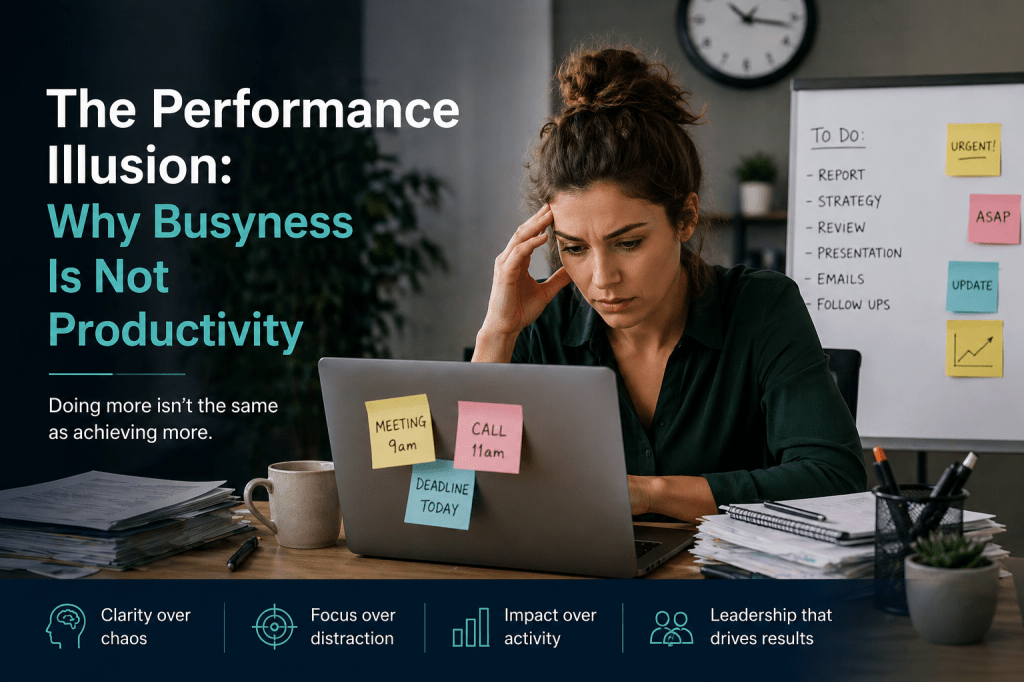
In many workplaces, busyness is still seen as a sign of value.
Full calendars.
Back-to-back meetings.
Constant messages.
Immediate responses.
On the surface, it looks like momentum.
But underneath, it often reflects something very different:
A system that rewards activity over effectiveness.
What Busyness Looks Like in Practice
Most teams are not intentionally inefficient.
They are responding to the environment around them.
That environment often includes:
- Constant interruptions
- High volumes of communication
- Unclear priorities
- Reactive decision-making
- Pressure to be visibly “on”
The result is a working day that feels full, but not always productive.
People move quickly between tasks, but struggle to complete meaningful work.
The Hidden Cost of Constant Activity
When busyness becomes the norm, performance starts to shift in subtle ways.
Reduced quality of thinking
Complex problems require focus. Constant switching reduces depth.
Increased errors
Attention is divided. Details are missed.
Delayed decision making
More time is spent reacting than analysing.
Higher cognitive load
The brain remains in a state of continuous processing.
Longer working hours
Work is pushed into evenings and weekends to “catch up.”
This is not a capacity issue.
It is a design issue.
Why Neurodivergent Employees Feel This More Intensely
For neurodivergent employees, the gap between busyness and productivity can feel even wider.
Many already manage:
- Increased cognitive processing demands
- Sensory input in busy environments
- Additional effort to interpret communication
- Pressure to mask or maintain consistency
When the environment adds constant interruption and unclear priorities, cognitive load increases rapidly.
The result is often:
- Faster fatigue
- Reduced focus
- Increased stress
- Higher burnout risk
This is not about ability.
It is about how the environment interacts with the brain.
What Productive Work Actually Requires
Productivity is not about how busy someone looks.
It is about whether the environment supports:
- Focus
- Clarity
- Energy management
- Decision making capacity
This means:
- Time to think without interruption
- Clear priorities and expectations
- Structured communication
- Reduced unnecessary noise
- Realistic pace
Without these, busyness replaces effectiveness.
What Inclusive Leaders Do Differently
Leaders who understand this shift their focus from activity to outcome.
That looks like:
Clarifying what matters most
Not everything is urgent. Priority must be visible.
Protecting focus time
Meetings and messages are reduced or structured.
Simplifying communication
Clear, direct messaging replaces ambiguity.
Reducing unnecessary work
Not all tasks add value. Some can be removed.
Modelling sustainable behaviour
Leaders demonstrate boundaries, not constant availability.
These changes are not dramatic.
But their impact is.
The Bigger Risk
The biggest risk of busyness is not inefficiency.
It is the illusion of performance.
When teams look active, it is easy to assume they are effective.
But over time, this leads to:
- Burnout
- Frustration
- Reduced engagement
- Lower quality outcomes
- Loss of high-performing staff
And by the time this becomes visible, the cost is already high.
Final Thoughts
Busyness is easy to see.
Productivity is harder to measure.
But organisations that focus on clarity, focus, and sustainable pace consistently outperform those that rely on constant activity.
The goal is not to do more.
It is to do what matters well, and sustainably.
NeuroTalks offers:
Corporate talks & fireside chats
Leadership communication sessions
Practical workshops
Psychological safety briefings
Strategy support for HR and people teams
👉 Contact us to explore availability and session options.

Leave a comment